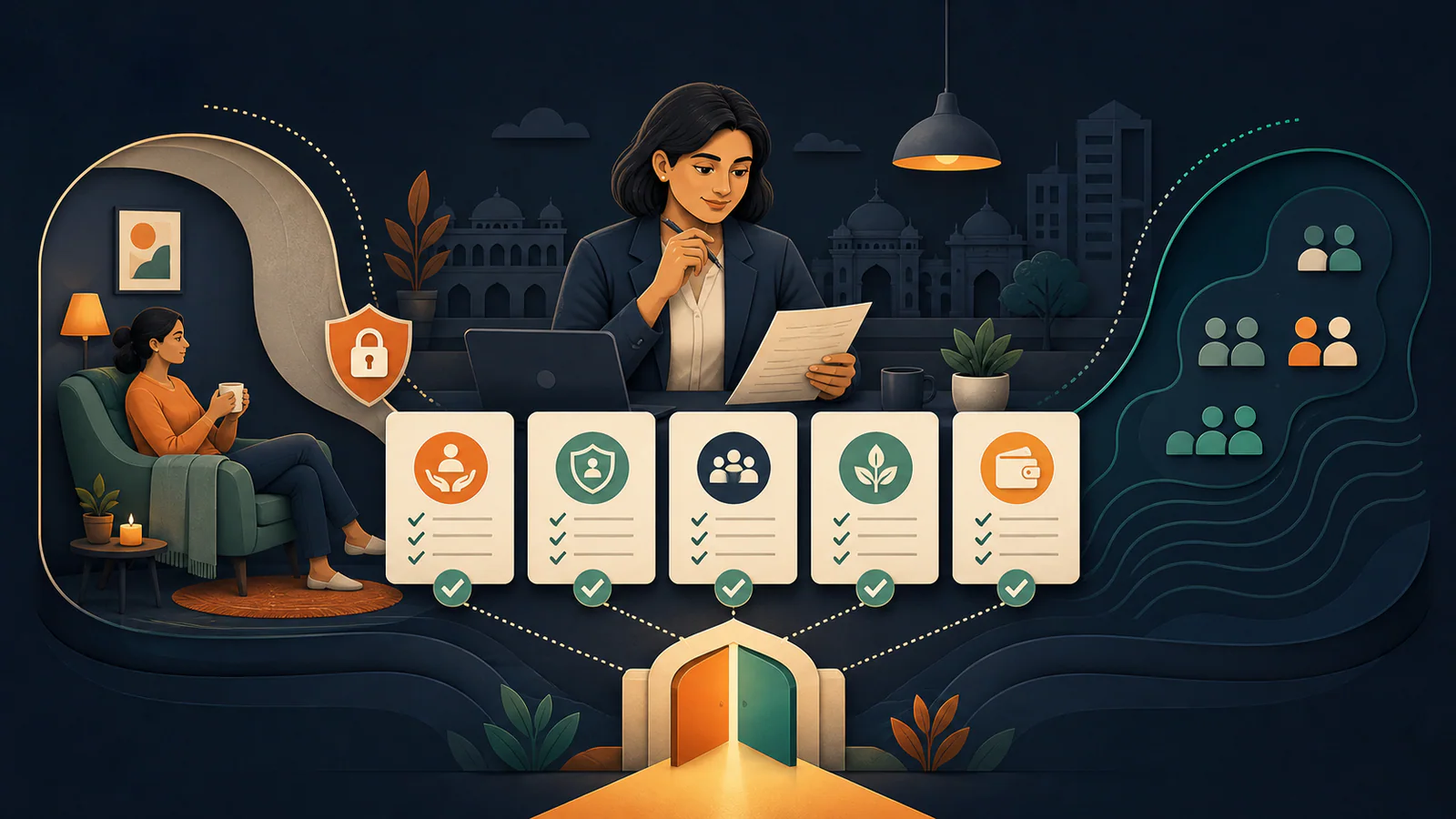
An employee wellbeing platform RFP in India should force vendors to prove privacy boundaries, workforce access, reporting quality, deployment readiness and total cost before price comparison begins.
A useful request for proposal is not a long feature wishlist. It is a controlled way to make competing vendors answer the same questions with the same evidence. For a workforce platform, the most important question is not how many activities appear in a demo. It is whether employees can use the service safely and whether HR receives useful, properly aggregated information without gaining access to individual reflections.
Start the RFP with risk, scope and outcomes
An employee wellbeing platform RFP is a structured document that asks vendors to respond against common business, privacy, access, reporting, implementation and commercial requirements. Its output should be a comparable evidence pack, not a stack of unrelated sales decks.
Put three outcomes at the top:
- Give employees a private, practical way to reflect and use everyday wellbeing tools.
- Give the organisation aggregate participation and programme signals without exposing individual entries.
- Give procurement a defensible record of why one vendor was selected.
The current frontline workforce platform guide helps define workforce needs. The EAP alternatives framework helps decide whether you need a replacement, a supplement or a different category altogether.
Use one evidence matrix for every vendor
The table below is a starting structure. Add sector-specific requirements, but do not let vendors replace it with their own format.
| RFP area | Ask the vendor | Strong evidence | Weak response |
|---|---|---|---|
| Employee access | Show first use for a frontline employee | Live mobile flow, language switch and low-bandwidth behaviour | Slides or a head-office-only demo |
| Privacy boundary | Show exactly what HR can and cannot see | Field-level sample outputs and role permissions | “Secure by design” without an output sample |
| Reporting | Provide a sample aggregate report | Participant counts, cohort rules and definitions | Colour scores without methodology |
| Implementation | Map the rollout from contract to first cohort | Named owners, dependencies and acceptance tests | A launch date without a dependency plan |
| Commercials | Price the full operating model | Seats, taxes, support, integrations and renewal terms | A headline rate with exclusions |
Make privacy answers testable
The Digital Personal Data Protection Act, 2023 separates notice, consent, data-fiduciary obligations and individual rights into distinct provisions. Your RFP should therefore separate them too. A general statement about alignment cannot replace an answer about purpose, access, retention or deletion.
Ask vendors to provide:
- The personal-data fields collected from an employee.
- The purpose attached to each field.
- The roles that can read each field and each derived output.
- The retention trigger and deletion method for each data class.
- The subprocessors used and the countries in which processing occurs.
- The employee notice and grievance route.
- The incident-response workflow and customer notification path.
Benchmark — statutory timeline: India Code records phased commencement, with many operational provisions scheduled for eighteen months from 13 November 2025. Procurement and legal teams should verify the applicable commencement schedule when the RFP is issued rather than relying on a vendor’s summary.
For any cohort report, require the vendor to state what happens when a group becomes very small. A participant count is useful context, but it is not automatically a privacy safeguard. The buyer should approve the minimum cohort rule and test it during the pilot.
Separate employee trust from employer reporting
Aggregate-only reporting means the employer receives group-level measures without receiving an individual’s journal, conversation, reflection or personal score. This is both a data boundary and an adoption condition: employees need a clear explanation of what their employer can and cannot see.
Ask the vendor to demo the same scenario twice:
- As an employee, complete a private reflection and request deletion.
- As an administrator, open the organisation report and show every field available.
Compare those screens side by side. If the admin output cannot be traced to a documented aggregation rule, keep the item open. If an incident channel exists, require separate routing, access and audit evidence rather than treating it as another dashboard tile.
ManoYatra’s privacy approach describes the public boundary buyers should validate in the product. ManoYatra provides aggregate organisational reporting; employers do not receive individual wellbeing entries. Procurement should verify that claim through current sample outputs and contract language, just as it should for every shortlisted vendor.
Test language and frontline access in the demo
A language count is not proof of usable access. Require vendors to demonstrate a complete task in the languages relevant to your workforce, including onboarding, navigation, consent or notice, the core activity and help text.
Use real operating conditions:
- An employee-owned Android device with limited storage.
- A shared or intermittently connected environment.
- A night-shift scenario outside support hours.
- Romanized input where employees naturally mix languages.
- A supervisor-free onboarding route so participation is voluntary in practice.
Score comprehension and task completion, not the number printed on a slide. Ask who maintains translated content, how changes are reviewed and whether support is available in the same language as the product experience.
Demand reporting definitions before dashboard design
A dashboard is only useful when every measure has a definition, denominator and update schedule. Ask for a data dictionary and a sample export before discussing colours or layouts.
For each measure, require:
- The population included and excluded.
- The minimum cohort behaviour.
- The refresh frequency.
- The handling of inactive and never-active seats.
- The difference between user-confirmed information and model-generated suggestions.
- The roles allowed to view and export the result.
- The audit record produced when sensitive reports are accessed.
The DPDP employee data guide provides a deeper procurement lens for purpose limitation, deletion and vendor accountability. Keep legal interpretation with qualified counsel; the RFP’s job is to make the vendor’s data flow visible enough for that review.
Score the pilot on proof, not promised outcomes
A pilot should test implementation and trust boundaries, not manufacture a success story. Do not ask vendors to promise changes in absenteeism, productivity or employee sentiment. Ask whether the service can be deployed, understood, used and governed as specified.
Use a pre-agreed scorecard. Estimate — sample weighting: allocate one quarter to privacy and trust, one quarter to employee access and usability, one fifth to reporting and governance, one sixth to implementation and support, and the balance to commercials. Adjust the weights before proposals arrive, document the reason and do not move them to favour a preferred vendor.
Price the operating model, not the licence line
Request a total-cost schedule covering subscription units, taxes, setup, integrations, training, support, renewal increases, exit assistance and data export.
Commercial comparison should begin only after must-have privacy and access requirements pass. A cheaper platform that employees do not trust or cannot use is not a saving; it is an unused contract with additional governance work.
Close the RFP with a decision sequence: compliance and privacy screen, employee-experience demo, reporting review, implementation validation, commercial scoring and final approval. If you want to evaluate ManoYatra against the same matrix, use the business overview and request a documented demo. Keep the questions unchanged for every vendor.
Sources
- Digital Personal Data Protection Act, 2023 and linked commencement notifications — India Code, Ministry of Electronics and Information Technology; enacted 11 August 2023, page checked 16 August 2026.
- Enforcement timeline for the Digital Personal Data Protection Act — India Code, notification dated 13 November 2025; checked 16 August 2026.
- Request-for-Proposal Toolkit — Personify Health; current page checked 16 August 2026.
- DPDP Platform RFP Checklist — Complynz; published 24 May 2026, checked 16 August 2026.